

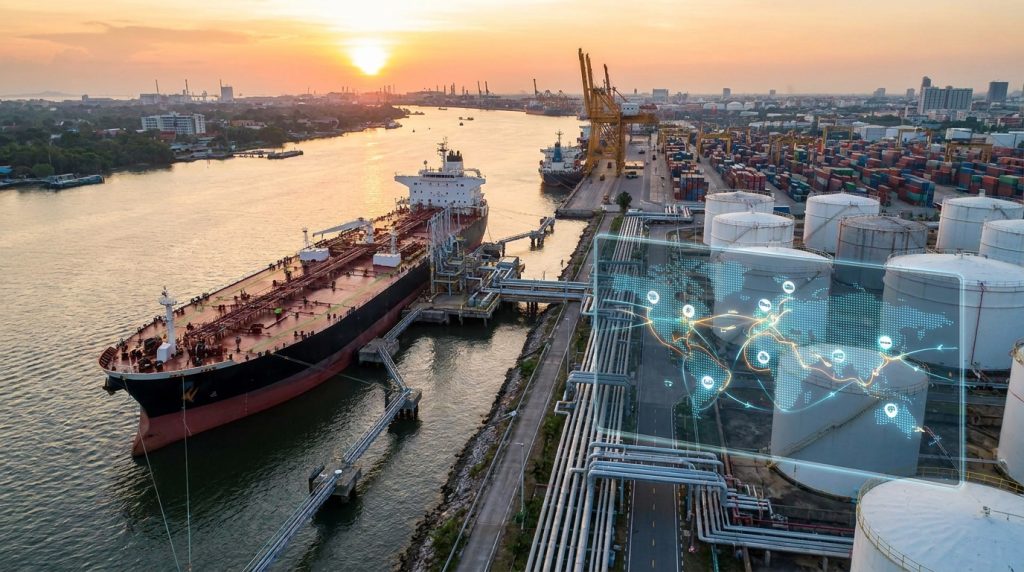
Energy supply chains and global trade routes are the essential systems that move energy resources from production sites to consumers across the world. These networks include the extraction of raw materials, refining processes, transportation infrastructure, and international shipping routes. Because energy demand is global while resources are unevenly distributed, these supply chains are highly interconnected and strategically important.
The first stage of the energy supply chain begins with extraction. Oil, natural gas, and coal are produced in specific regions depending on geological availability. Countries in the Middle East, North America, and Russia are among the largest producers of fossil fuels. Once extracted, these resources are transported to refineries through pipelines, railways, or shipping networks for processing into usable products such as gasoline, diesel, and jet fuel.
After refining, energy products enter global trade routes. Maritime transport plays a dominant role in this process. Large tanker ships carry crude oil and liquefied natural gas across oceans to importing countries. These shipping routes are often long and complex, passing through key chokepoints that are critical for global energy security.
One of the most important chokepoints is the Strait of Hormuz, through which a significant share of the world’s oil exports passes from the Persian Gulf to international markets. Any disruption in this narrow passage can have immediate effects on global supply and pricing. Similarly, the Strait of Malacca is another vital route, especially for energy shipments heading to East Asian economies such as China, Japan, and South Korea.
Other major routes include the Suez Canal, which connects the Red Sea to the Mediterranean Sea, and the Panama Canal, which links the Atlantic and Pacific Oceans. These canals significantly reduce transportation time and cost, making global energy trade more efficient. Any blockage or delay in these routes can disrupt supply chains and increase energy prices worldwide.
In addition to maritime transport, pipelines are a key part of energy supply chains. They provide a continuous and cost-effective way to move oil and natural gas over land. For example, extensive pipeline networks connect Russia to European markets and North American production sites to domestic refineries. Pipelines are often considered more secure than shipping routes, but they are still vulnerable to political tensions and infrastructure risks.
Liquefied natural gas (LNG) has added flexibility to global energy trade. By cooling natural gas into a liquid state, it can be transported by specialized ships to countries without pipeline access. This has expanded global trade routes and increased competition among suppliers, particularly between the United States, Qatar, and Australia.
Energy supply chains are also influenced by geopolitical relationships. Countries that control key resources or transit routes can impact global energy availability and pricing. As a result, energy security has become a major focus for governments, leading to diversification of suppliers and investment in strategic reserves.
In conclusion, energy supply chains and global trade routes form a complex system that connects producers and consumers across the world. These networks rely on a combination of pipelines, shipping lanes, and processing infrastructure, all of which are influenced by geography, politics, and economic demand. As global energy consumption evolves, these supply chains will continue to adapt to new technologies and shifting international dynamics.