

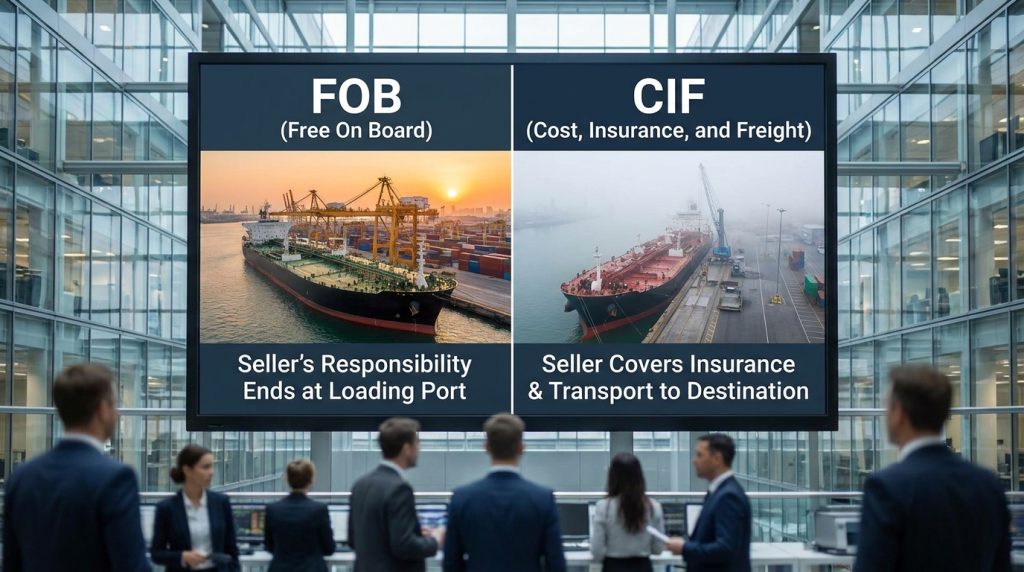
In international petroleum trading, delivery terms play a crucial role in defining responsibilities between buyers and sellers. Two of the most commonly used terms are FOB (Free on Board) and CIF (Cost, Insurance, and Freight). These terms are part of international trade rules known as Incoterms, and they determine who bears the cost, risk, and responsibility at different stages of shipment. Understanding the difference between FOB and CIF is essential for anyone involved in global oil and energy markets.
FOB, or Free on Board, means that the seller is responsible for delivering the petroleum product to the loading port and ensuring it is placed on board the vessel nominated by the buyer. Once the oil crosses the ship’s rail at the port of origin, the responsibility and risk transfer to the buyer. From that point onward, the buyer handles shipping costs, insurance, and any risks associated with transportation.
In FOB agreements, buyers have greater control over the shipping process. They choose the vessel, negotiate freight rates, and arrange insurance if needed. This flexibility is particularly useful for large oil companies and experienced traders who want to optimize logistics and reduce costs based on market conditions. However, it also means they carry more responsibility once the cargo is loaded.
CIF, or Cost, Insurance, and Freight, works differently. Under CIF terms, the seller is responsible not only for delivering the petroleum to the port of destination but also for covering shipping costs and insurance during transit. The risk still transfers to the buyer once the goods are loaded onto the vessel, but the seller pays for transportation and insurance up to the destination port.
This arrangement is often preferred by buyers who want a more simplified purchasing process. Since the seller manages shipping and insurance, CIF reduces the logistical burden on the buyer. However, it may come at a higher overall cost because the seller typically includes transportation and insurance expenses in the final price.
One key difference between FOB and CIF is control over logistics. FOB gives control to the buyer, while CIF gives control to the seller. In volatile shipping markets, control over freight rates can significantly impact total costs. For example, during periods of high shipping demand, buyers using FOB contracts may struggle to secure affordable vessels, whereas CIF buyers are shielded from these fluctuations.
Another important distinction is transparency. FOB transactions often provide clearer visibility into shipping costs because the buyer arranges transportation directly. In CIF contracts, shipping and insurance costs are embedded in the contract price, which can make it harder for buyers to assess individual cost components.
Risk management is also a critical factor. In FOB contracts, buyers assume risk earlier in the supply chain, immediately after loading. In CIF contracts, although sellers pay for insurance, the risk still technically transfers at the loading point, which means buyers must rely on the seller’s insurance arrangements.
Both FOB and CIF are widely used in petroleum trading depending on market conditions, negotiation power, and operational preferences. Large trading companies often prefer FOB for flexibility, while smaller buyers or less experienced market participants may choose CIF for convenience and reduced logistical responsibility.
In conclusion, FOB and CIF represent two different approaches to structuring petroleum trade transactions. FOB emphasizes buyer control and responsibility, while CIF focuses on seller-managed logistics and cost inclusion. Choosing between them depends on factors such as risk appetite, market conditions, and operational capability in the global energy trade environment.