

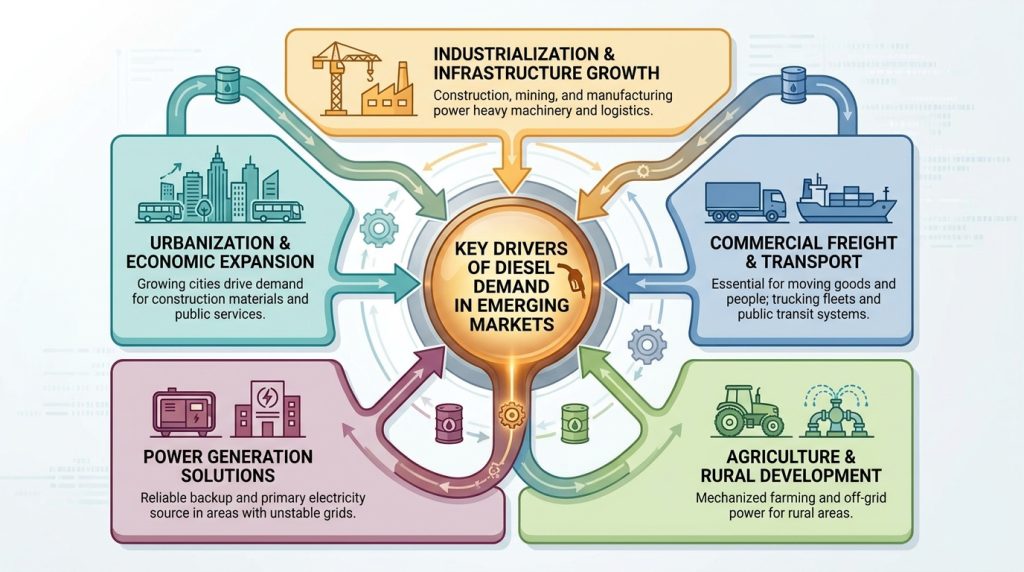
Diesel demand in emerging markets is shaped by rapid economic development, expanding infrastructure, growing industrial activity, and rising transportation needs. Unlike mature economies where diesel consumption is stabilizing or declining in some sectors, emerging markets continue to show strong growth because diesel remains a primary fuel for mobility, agriculture, and power generation.
One of the most important drivers is transportation and logistics expansion. Emerging economies are experiencing rapid growth in road freight, e-commerce delivery networks, and intercity transport systems. Heavy-duty trucks, buses, and commercial vehicles rely heavily on diesel due to its efficiency and high energy output. As trade and manufacturing expand, diesel consumption increases in parallel to support the movement of goods across regions.
Industrialization and construction activity are another major factor. Emerging markets are investing heavily in infrastructure such as roads, bridges, ports, railways, and industrial zones. Diesel-powered machinery, including excavators, cranes, bulldozers, and generators, is widely used in construction projects. Mining operations, which are common in resource-rich developing countries, also depend heavily on diesel for extraction and transport activities.
Agriculture is a third key driver. In many emerging economies, agriculture still plays a significant role in GDP and employment. Diesel fuels tractors, irrigation pumps, harvesters, and transport vehicles used in rural supply chains. Seasonal farming cycles often create predictable spikes in diesel demand, especially during planting and harvesting periods.
Another important factor is limited electrification and energy infrastructure gaps. In many regions, electricity supply is unreliable or unavailable in rural and remote areas. Diesel generators are widely used as backup or primary power sources for homes, businesses, hospitals, and industrial facilities. This dependence significantly increases diesel consumption in areas with weak grid infrastructure.
Rapid urbanization and population growth also contribute to rising diesel demand. As cities expand, the need for public transportation, construction, and freight services increases. Urban centers rely heavily on diesel-powered buses and commercial fleets to support daily mobility and economic activity.
Pricing dynamics also influence diesel demand. In many emerging markets, government subsidies or regulated pricing systems help maintain affordability, which supports higher consumption levels. However, when subsidies are reduced or global oil prices rise, demand patterns can become more volatile. Diesel prices are closely linked to global crude benchmarks such as Brent crude oil, meaning international market fluctuations directly impact local economies.
Energy trading and supply chains also play a role in ensuring availability. Companies such as Vitol and Trafigura help manage global diesel flows by sourcing fuel from refining hubs and distributing it to high-demand regions. Their logistics networks are essential for maintaining consistent supply, especially in countries with limited refining capacity.
Finally, slow transition to alternative fuels is a key reason diesel demand remains strong. While electric vehicles and renewable energy are growing, their adoption in emerging markets is still limited due to cost, infrastructure constraints, and technological barriers. As a result, diesel continues to dominate transportation and industrial energy use.
In conclusion, diesel demand in emerging markets is driven by structural economic growth, infrastructure development, agriculture, and energy access limitations. Although long-term energy transitions may gradually reshape consumption patterns, diesel will remain a critical fuel for development and industrial expansion in these regions for many years.