

Executive Summary
Energy markets are inherently volatile, influenced by geopolitical events, supply disruptions, logistics constraints, and fluctuating global demand. Businesses that rely on petroleum products often face challenges in managing cost uncertainty and ensuring consistent fuel supply. Energy consultants play a critical role in helping organizations interpret market signals, assess risks, and structure procurement strategies aligned with operational requirements.
Through market analysis, supply chain understanding, and strategic advisory, energy consultants assist businesses in navigating complex petroleum markets while maintaining operational stability.
Contents
- Introduction to Energy Market Volatility
- Key Drivers of Fuel Price Fluctuations
- Role of Energy Consultants in Market Analysis
- Strategic Fuel Procurement Planning
- Risk Management in Energy Markets
- Supply Chain Visibility and Coordination
- Decision-Making in Uncertain Environments
- Strategic Insights for Businesses
- Conclusion
Introduction to Energy Market Volatility
Global energy markets are subject to constant change. Price fluctuations occur due to a combination of supply constraints, geopolitical developments, economic cycles, and infrastructure limitations. For businesses dependent on fuel supply, such volatility can directly impact operating costs and long-term planning.
Unlike stable commodity markets, petroleum markets respond rapidly to external factors. This dynamic environment requires continuous monitoring and informed decision-making to maintain supply continuity and cost control.
Key Drivers of Fuel Price Fluctuations
Fuel prices are influenced by several interconnected factors. Crude oil production levels, refinery capacity, transportation logistics, and geopolitical developments all play a role in shaping market conditions.
Unexpected disruptions such as supply shortages, shipping delays, or regulatory changes can cause rapid price movements. Additionally, seasonal demand patterns, particularly in transportation and industrial sectors, contribute to market volatility.
Understanding these drivers is essential for businesses seeking to manage fuel-related risks.
Role of Energy Consultants in Market Analysis
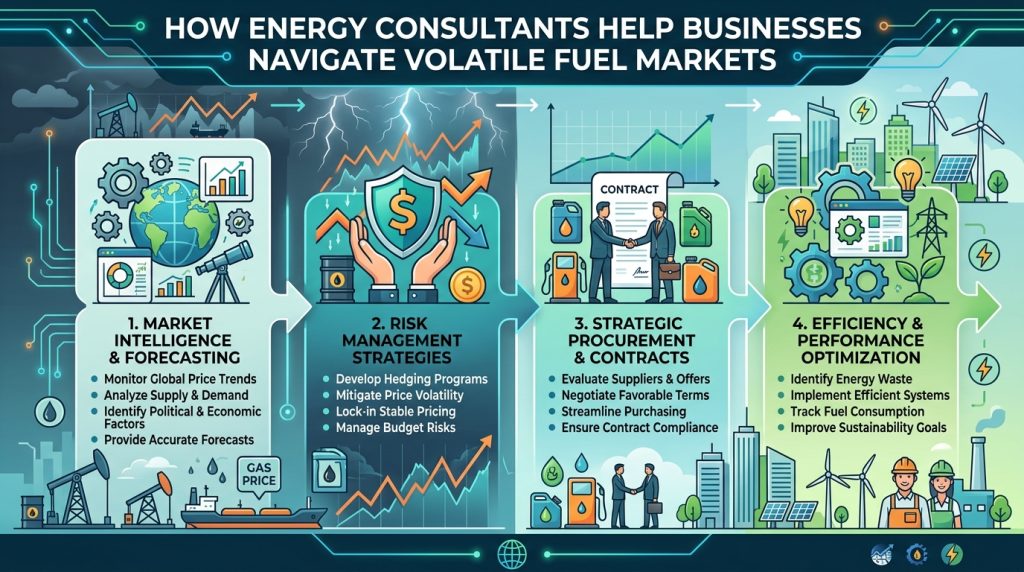
Energy consultants provide structured insights into market behavior by analyzing global trends, supply-demand balances, and pricing mechanisms. Their role involves interpreting complex data and translating it into actionable information for businesses.
By monitoring developments across global energy markets, consultants help organizations anticipate potential disruptions and adjust their strategies accordingly. This proactive approach enables businesses to respond effectively to changing market conditions.
Strategic Fuel Procurement Planning
Effective fuel procurement requires more than price comparison. Businesses must consider supply reliability, delivery timelines, contract structures, and logistical feasibility.
Energy consultants assist in designing procurement strategies that align with operational requirements. This may include identifying suitable suppliers, evaluating contract terms, and determining optimal purchasing timelines.
A structured procurement approach helps businesses reduce exposure to price volatility while ensuring consistent fuel availability.
Risk Management in Energy Markets
Risk management is a central component of energy consultancy. Businesses operating in petroleum markets face risks related to pricing fluctuations, supply disruptions, and logistical constraints.
Consultants help identify potential risks and develop mitigation strategies. These may include diversified sourcing, flexible contract structures, and contingency planning.
By addressing these risks proactively, businesses can maintain operational continuity even in uncertain market conditions.
Supply Chain Visibility and Coordination
Petroleum supply chains involve multiple stages, including production, refining, storage, and transportation. Limited visibility across these stages can lead to inefficiencies and disruptions.
Energy consultants provide insights into supply chain operations, helping businesses understand how fuel moves from source to destination. This improved visibility supports better coordination and reduces the likelihood of delays.
Decision-Making in Uncertain Environments
Uncertainty is a defining characteristic of global energy markets. Businesses must often make decisions based on incomplete information and rapidly changing conditions.
Energy consultants support decision-making by providing structured analysis and scenario-based insights. This allows organizations to evaluate different outcomes and select strategies that align with their objectives.
Strategic Insights for Businesses
Organizations operating in energy-intensive industries benefit from a structured approach to market engagement. Understanding market dynamics, managing risks, and optimizing procurement strategies contribute to long-term stability.
Energy consultancy provides the framework needed to navigate complex petroleum markets while maintaining operational efficiency.
Conclusion
Energy market volatility presents both challenges and opportunities for businesses. By leveraging professional advisory services, organizations can better understand market dynamics, manage risks, and develop effective procurement strategies.
As global energy systems continue to evolve, the role of informed decision-making and structured market analysis will remain critical for businesses operating within petroleum supply chains.
Frequently Asked Questions
What causes fuel price volatility?
Fuel price volatility is influenced by supply disruptions, geopolitical events, demand fluctuations, and logistical constraints.
How do energy consultants help businesses?
They provide market insights, risk analysis, and procurement strategies to help businesses manage energy-related challenges.