

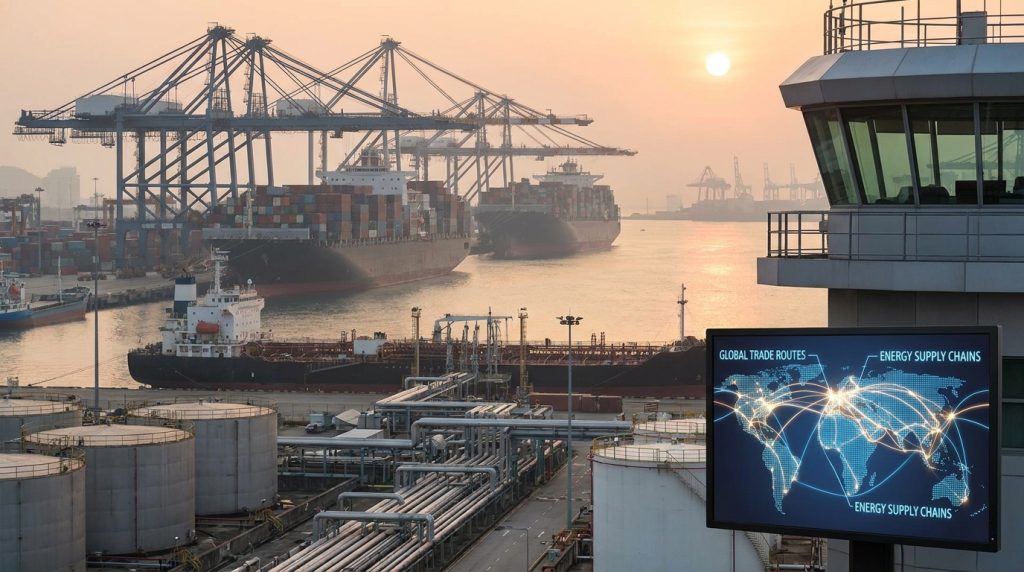
Energy supply chains and global trade routes form the backbone of the modern global economy. From oil and natural gas to coal and increasingly liquefied natural gas and electricity, energy must move across continents to reach industries, households, and transport systems. The structure of these supply chains is complex, involving extraction, processing, transportation, and distribution across highly interconnected networks.
A major part of global energy trade depends on strategic maritime chokepoints. One of the most important is the Strait of Hormuz, which connects oil-producing countries in the Middle East to global markets. A significant portion of the world’s crude oil passes through this narrow waterway every day. Any disruption in this region can have immediate effects on global oil prices and energy security.
Another critical route is the Suez Canal, which links the Red Sea to the Mediterranean Sea. It is a vital shortcut for energy shipments traveling between Asia, the Middle East, and Europe. This canal significantly reduces travel time compared to sailing around Africa, making it essential for efficient global trade. Similarly, the Panama Canal plays a key role in connecting energy flows between the Atlantic and Pacific Oceans, especially for liquefied natural gas and petroleum products.
In Asia, the Strait of Malacca is another crucial chokepoint. It is one of the busiest shipping lanes in the world and serves as a major transit route for oil and gas supplies heading to energy-hungry economies such as China, Japan, and South Korea. Due to its strategic importance, any disruption in this area could have widespread economic consequences.
Beyond maritime routes, pipelines are essential components of global energy supply chains. Countries with large reserves of oil and gas often rely on extensive pipeline networks to transport energy to domestic and international markets. For example, Russia has historically been a major supplier of natural gas to Europe through a network of pipelines that cross multiple countries. These pipelines highlight how energy trade is not only economic but also deeply geopolitical.
In recent years, liquefied natural gas (LNG) has transformed global energy trade. LNG can be transported by specialized ships, allowing countries to diversify their energy sources beyond fixed pipelines. This flexibility has increased global competition and created new trade routes, especially between the United States, Qatar, and Asian markets.
Renewable energy is also beginning to influence global supply chains. While solar and wind energy are typically consumed locally, cross-border electricity trade is growing through interconnected power grids. Some regions are investing in large-scale transmission projects to share renewable energy across borders, improving stability and reducing dependence on fossil fuels.
In conclusion, energy supply chains and global trade routes are vital to maintaining the flow of resources that power the modern world. They are shaped by geography, technology, and international relations. As global energy demand evolves, these networks will continue to adapt, becoming more diversified, flexible, and interconnected.