

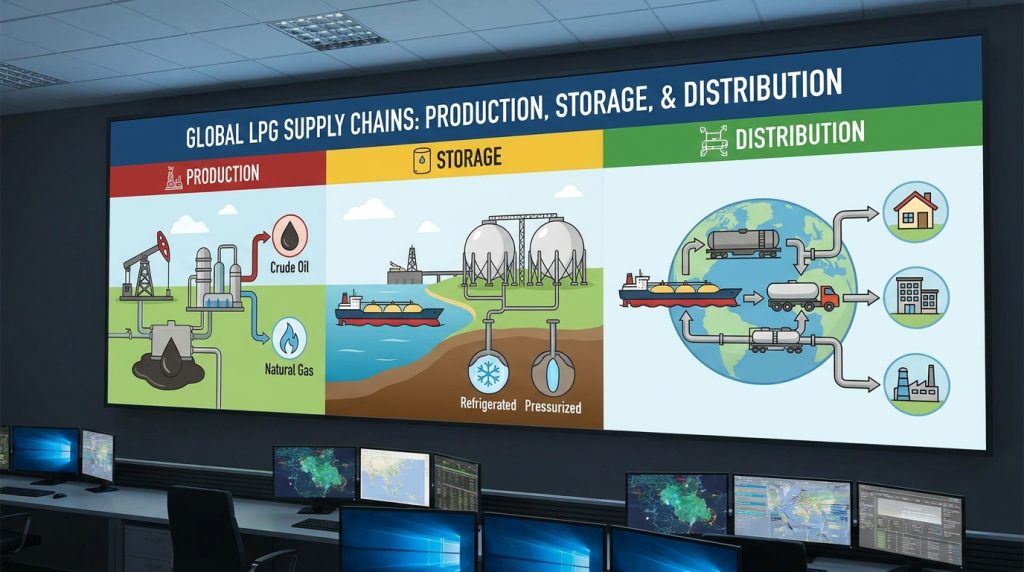
Liquefied Petroleum Gas (LPG) is a widely used energy source for cooking, heating, transportation, and industrial applications. Its global supply chain is a complex system that connects production sites, storage facilities, transportation networks, and end users. Because LPG is portable, efficient, and relatively clean compared to other fossil fuels, its demand continues to grow across both developed and emerging markets.
The supply chain begins with production. LPG is primarily produced as a byproduct of natural gas processing and crude oil refining. During natural gas extraction, heavier hydrocarbons such as propane and butane are separated and processed into LPG. Similarly, oil refineries generate LPG while converting crude oil into fuels like gasoline and diesel. Major producing regions include the Middle East, the United States, and parts of Asia, where large-scale energy infrastructure supports high output levels.
Once produced, LPG moves to the storage stage, which is critical due to its pressurized and liquid form. LPG is stored in specially designed tanks that maintain pressure to keep the gas in liquid form. These storage facilities are located near refineries, ports, and distribution hubs. Large storage terminals allow suppliers to manage supply fluctuations and maintain consistent availability, especially during periods of high demand.
Transportation is a key component of the LPG supply chain. LPG is moved internationally using specialized ships designed to carry liquefied gases under pressure or at low temperatures. These vessels transport large volumes across global trade routes, often passing through strategic chokepoints such as the Strait of Hormuz and the Strait of Malacca. Any disruption in these routes can affect global LPG availability and pricing.
For regional and domestic distribution, LPG is transported through pipelines, railcars, tanker trucks, and cylinder distribution systems. In many developing countries, LPG cylinders are the primary method of delivery to households. These cylinders are filled at bottling plants and distributed through retail networks, making LPG accessible even in areas without pipeline infrastructure.
Global trading companies play an important role in LPG supply chains by coordinating supply, logistics, and market distribution. Firms such as Vitol and Trafigura manage large volumes of LPG, optimizing trade routes and ensuring that supply reaches high-demand regions efficiently. Their ability to balance global supply and demand helps stabilize the market.
Pricing of LPG is influenced by global energy benchmarks and regional demand patterns. While LPG does not have a single universal benchmark like crude oil, its pricing is often linked to crude oil indices such as Brent crude oil and regional supply-demand conditions. Seasonal factors, such as increased heating demand in winter, can also impact prices.
Safety and regulation are critical throughout the LPG supply chain. Because LPG is flammable, strict standards govern its storage, handling, and transportation. Governments and international organizations enforce safety protocols to prevent accidents and ensure reliable operations.
In recent years, the LPG supply chain has evolved with improvements in infrastructure, digital monitoring systems, and environmental considerations. LPG is often promoted as a transition fuel because it produces fewer emissions than coal or biomass, particularly in household use.
In conclusion, the global LPG supply chain is a well-coordinated system that spans production, storage, transportation, and distribution. Its flexibility and accessibility make it a vital energy source for millions of people worldwide, while ongoing advancements continue to improve efficiency, safety, and sustainability in the sector.