

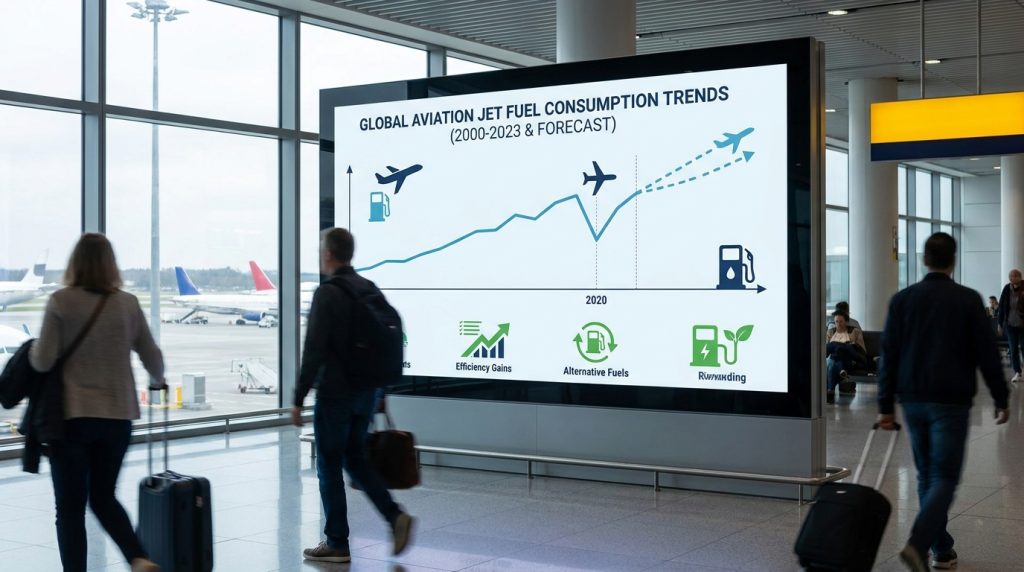
Jet fuel consumption is a key indicator of activity in the global aviation industry, reflecting passenger travel demand, cargo movement, economic growth, and operational efficiency of airlines. Over the past two decades, consumption patterns have shifted significantly due to economic cycles, technological improvements, and structural changes in global air travel.
A major long-term trend is the steady growth in global jet fuel demand, driven by rising air travel in both domestic and international markets. Before the pandemic, aviation fuel consumption consistently increased due to expanding middle-class populations, especially in Asia-Pacific regions. As economies grow, more people travel for business, tourism, and education, directly increasing fuel usage. Recent data shows that global aviation fuel demand has largely recovered to near pre-pandemic levels and is expected to continue rising in the long term as air travel expands again.
However, consumption growth is no longer as rapid as it was in earlier decades. One important reason is improving fuel efficiency in modern aircraft. New-generation airplanes are designed to use less fuel per passenger-kilometer, reducing overall consumption growth even as flight volumes increase. Airlines are also optimizing flight routes, reducing unnecessary fuel burn, and adopting more efficient operational practices. This means that demand for jet fuel is growing more slowly than air traffic itself.
Another important trend is the post-pandemic recovery pattern. During the COVID-19 pandemic, jet fuel consumption dropped sharply due to global travel restrictions. As restrictions eased, demand rebounded strongly, especially in 2022 and 2023. However, recovery has not been perfectly uniform. Domestic and short-haul travel recovered faster, while international long-haul travel took longer to return to normal levels. In some regions, consumption has still not fully reached pre-pandemic peaks due to changes in travel behavior and airline capacity adjustments.
The aviation industry also shows a growing influence of economic conditions on fuel consumption. When global economies slow down, business travel and cargo demand decrease, leading to lower jet fuel usage. Conversely, strong economic growth typically results in increased air travel and higher fuel demand. Inflation, ticket prices, and airline profitability also indirectly influence consumption trends by affecting passenger demand.
A more recent structural trend is the push toward sustainability and alternative fuels. Airlines and governments are investing in sustainable aviation fuels (SAF) to reduce carbon emissions. However, SAF currently represents only a very small share of total aviation fuel consumption, meaning conventional jet fuel still dominates global demand. The transition to cleaner fuels is expected to gradually reshape long-term consumption patterns rather than cause immediate reductions.
Geopolitical and supply chain factors also play a role. Disruptions in oil markets, refinery output, or key shipping routes can temporarily affect jet fuel availability and pricing, which in turn influences consumption behavior by airlines through hedging, route optimization, or capacity adjustments.
In conclusion, global jet fuel consumption trends reflect a balance between rising air travel demand and improving efficiency in aviation technology. While long-term demand is expected to grow, the pace is moderated by fuel efficiency gains, economic cycles, and the gradual transition toward sustainable aviation fuels.